
By Rosemary Okoduwa
The Edo State Government, through its Ministry of Women Affairs and Social Development, has partnered with the Rule of Law and Anti-Corruption (RoLAC) programme to develop a comprehensive policy framework aimed at tackling Technology Facilitated Gender-Based Violence (TF-GBV) in the state.

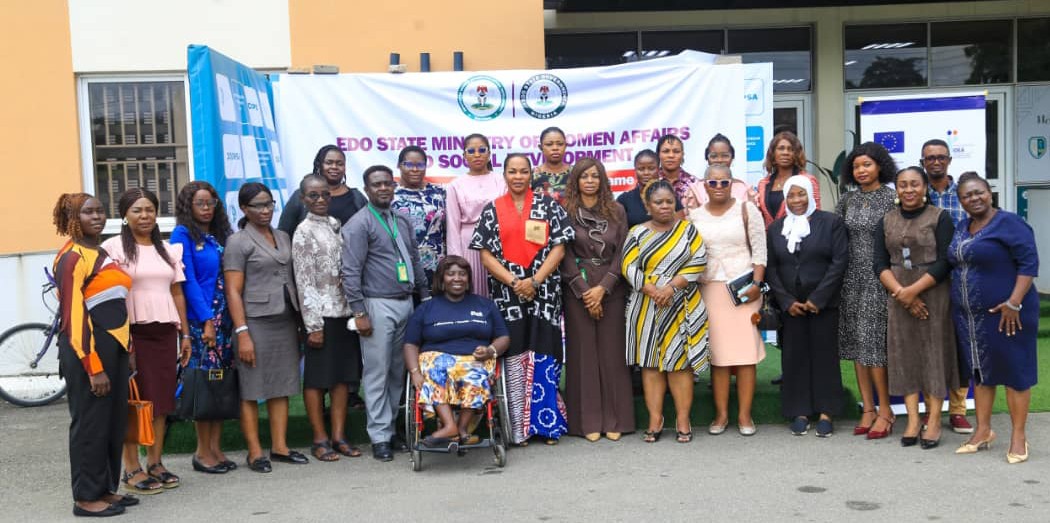
The initiative was unveiled at an inception meeting held at the John Odigie Oyegun Public Service Academy (JOOPSA) in Benin City, where key stakeholders from government institutions, law enforcement agencies, and civil society organisations converged to address the rising cases of online harassment, cyberstalking, and non-consensual sharing of intimate images.
Speaking at the event, the Honourable Commissioner for Women Affairs and Social Development, Hon. Eugenia Abdallah, described the initiative as timely and necessary. She noted that while Edo State has made notable progress in addressing conventional forms of gender-based violence, emerging digital threats require proactive and forward-looking policy responses.
“As our society becomes increasingly digital, we are witnessing a troubling rise in new forms of gender-based violence perpetrated through technology,” she said. “These violations not only undermine the dignity of women and girls but also limit their participation in economic and public life.”

The Commissioner commended the collaboration with RoLAC, highlighting its contribution to strengthening justice delivery and institutional accountability in Edo State.
In her remarks, the RoLAC State Coordinator, Uche Nwokedi, stressed the urgent need for a dedicated state policy, noting that existing legal frameworks do not sufficiently address the digital dimensions of gender-based violence. She added that the policy development process would also explore possible amendments to the Violence Against Persons Prohibition (VAPP) Law to ensure effective prosecution of offenders.


“The laws we currently have do not explicitly provide adequate punishment for technology-facilitated gender-based violence,” Nwokedi stated, noting that a specialised drafting committee will work in the coming months to produce a policy aligned with global best practices.
Providing a technical overview, RoLAC representative, Omokhodion Imonitie, presented the “TF-GBV Zero Draft,” which will serve as the foundation for the policy document. He explained that the draft seeks to clearly define digital offences and establish survivor-centred response mechanisms that prioritise access to justice and protection.
During breakout sessions, stakeholders identified key priority areas, including legal reform and enforcement, survivor-centred reporting systems, digital literacy and prevention strategies, and stronger institutional accountability.
A major highlight of the meeting was the inauguration of a Technical Working Group (TWG) tasked with refining the Zero Draft into a final policy document. The TWG comprises representatives from relevant Ministries, Departments and Agencies (MDAs), the Nigeria Police, civil society organisations, and legal practitioners.
Charging members of the TWG, Hon. Abdallah urged them to be guided by the lived realities of survivors, stressing that the policy must go beyond documentation to serve as a practical tool for justice and protection.
The Technical Working Group is expected to conclude its assignment in the coming months, positioning Edo State as a leading voice in Nigeria’s response to emerging forms of gender-based violence in digital spaces.
Discover more from DE-PATRIOT
Subscribe to get the latest posts sent to your email.